
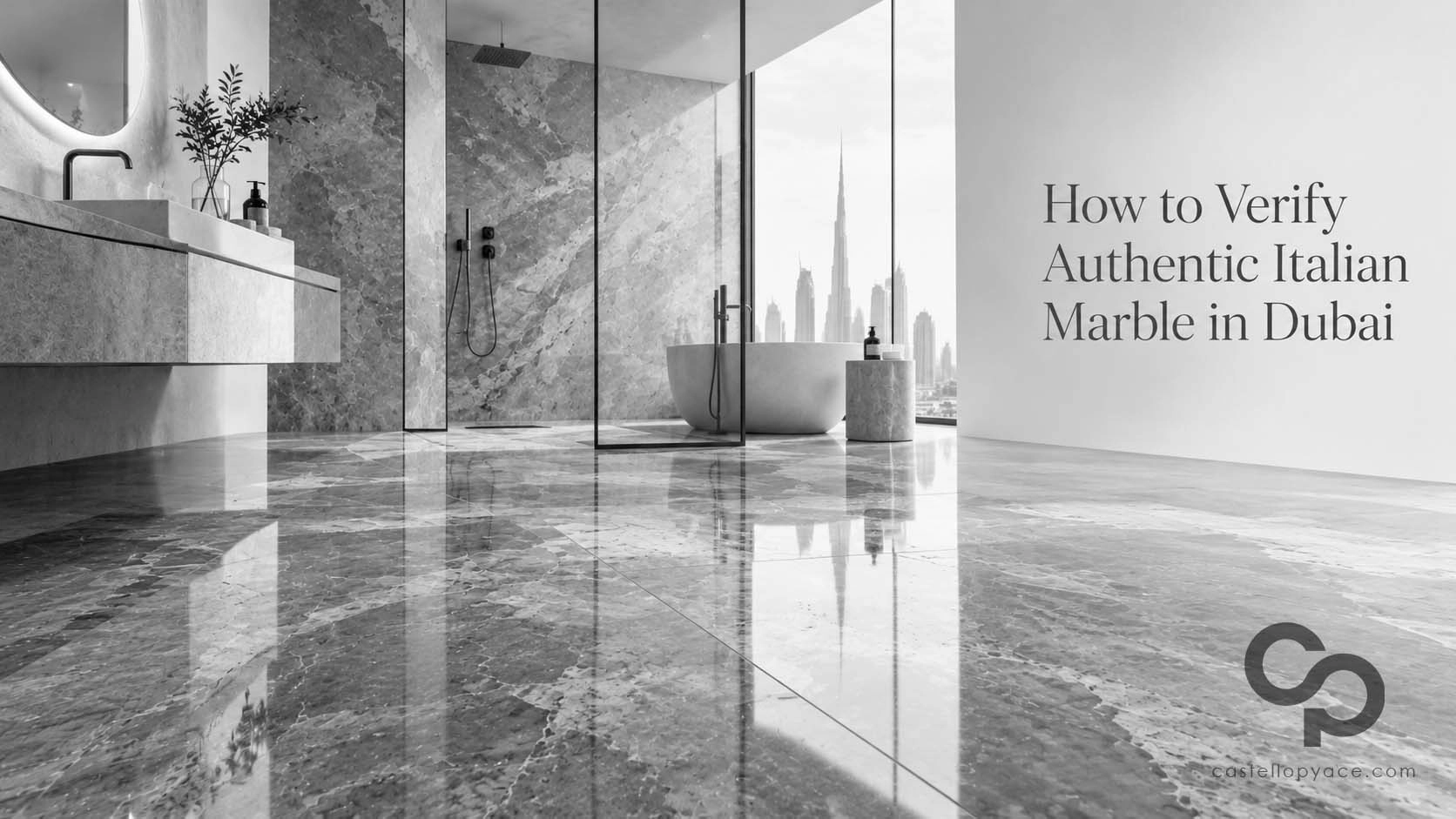
How to Verify Authentic Italian Marble in Dubai
In a luxury interior, marble is rarely just a surface covering. Its natural pattern, finish, and proportions can influence the character of an entire space. A good-looking slab is not enough to justify the choice, though. When specifying Italian marble in Dubai, architects, interior designers, and property developers need to understand its origin, assess its quality, and confirm that it meets the project's requirements.
A well-informed selection process begins with three things: reliable material documentation, careful inspection of the actual slabs, and a clear understanding of how the stone will perform in its intended application. Together, they confirm that the material suits both the design and the practical demands of the project.
Italian Marble Selection for Luxury Projects in Dubai
Selecting marble for a luxury villa, hotel, or commercial interior requires a balance between aesthetics, technical suitability, and material consistency. A stone that works beautifully on a feature wall may not be the most practical choice for a heavily used floor or staircase.
At CASTELLO PYACE, we support architects, interior designers, developers, and high-end builders through curated access to premium European materials, natural stone, and architectural finishes. Our approach is centred on understanding each project's requirements and coordinating material selection and sourcing to suit the intended application.
For a statement staircase, for example, the priority may be the continuity of the veining across individual treads and risers. In a villa entrance, the background colour, surface finish, and relationship between the stone and surrounding materials may be equally important. For larger developments, consistency across multiple slabs and dependable supply coordination can become central to the specification process.
CASTELLO PYACE was established as a specialised building clinic for the luxury construction sector, bringing international brands and material expertise together to support architects and designers. Honesty and high-quality service are the principles the company works by.
You can explore the CASTELLO PYACE brand portfolio to understand the range of European materials and design solutions available for different project requirements.

What Does Authentic Italian Marble Actually Mean?
Authentic Italian marble is natural marble quarried in Italy. However, the country where a product is manufactured, processed, or sold is not necessarily the country where its raw stone originated.
The distinction matters because luxury building materials often pass through several stages before they reach a project in Dubai. Natural stone may be extracted in one country, cut and polished in another, and supplied by a distributor based elsewhere.
When specifying marble, separate three different considerations:
Quarry origin: This identifies where the natural stone was extracted. If Italian geological origin is a requirement, the material should be traceable to its stated Italian quarry or source region.
Processing and fabrication: Cutting, polishing, resin treatment, and other finishing operations can take place outside Italy. These processes affect the finished product but do not change where the stone was originally quarried.
Brand and product origin: An Italian brand may offer natural stone, engineered surfaces, porcelain tiles, or decorative architectural products. The brand's nationality alone does not establish the origin or composition of every material in its collection.
Consider Carrara marble, which originates in the Apuan Alps of Tuscany. The International Union of Geological Sciences identifies the region as an important marble-producing area with numerous commercial varieties, including Bianco Carrara, Statuario, and Calacatta.
In practice, product names, country-of-manufacture statements, and quarry origin each need to be checked on their own. When a specification requires marble quarried in Italy, that requirement should be recorded explicitly in the purchase documents.
How to Verify Italian Marble Origin and Documentation
Material documentation provides a foundation for verifying the declared origin of natural stone. For a residential or commercial project, the goal is not simply to collect paperwork. It is to establish a clear relationship between the stated material, its source, the supplied batch, and the slabs approved for installation.
A Certificate of Origin can support a product's declared country of origin, while commercial and shipping records help establish the identity of the goods being supplied. These documents should be reviewed together because a certificate that refers to a shipment does not automatically identify every individual slab within a separate order.
The most useful records include:
|
Document or record |
What it helps establish |
|
Certificate of Origin |
The declared country of origin of the goods |
|
Commercial invoice |
The seller, transaction, quantity, and product description |
|
Packing list |
The packages, quantities, and shipping details associated with the shipment |
|
Quarry or producer declaration |
The stated source, quarry, or producer information |
|
Bundle or slab references |
The relationship between selected slabs and the supplied batch |
|
Technical data sheet |
Available information about material properties, dimensions, finish, and relevant specifications |
|
Inspection or quality records |
The condition and conformity of the material against agreed requirements |
The information should be consistent across the documents. If the invoice describes a different variety from the material specification, or if bundle references cannot be matched to the selected slabs, request clarification before final approval.
For a project involving extensive marble surfaces, it is helpful to record the selected variety, finish, thickness, source information, and slab identification in the material schedule. This gives the design team and procurement manager a common reference throughout the selection and fabrication process.
Documentation also has limits. A product label or supplier declaration should not be treated as independent geological proof. Where the project requires additional assurance, a qualified stone specialist or appropriate laboratory can advise on further verification.
These checks are there to support a sound material specification, without adding needless steps to purchasing.

Natural Marble vs Marble-Look Porcelain: Choosing the Right Material
Natural marble and marble-look porcelain can both work well in sophisticated interiors, but they offer different material characteristics and should not be specified as if they were interchangeable.
Natural marble forms through geological processes and has a mineral structure, natural variations, and veining that differ from slab to slab. Porcelain is manufactured and can reproduce the appearance of marble through printed patterns, surface textures, and other production techniques.
|
Consideration |
Natural marble |
Marble-look porcelain |
|
Appearance |
Natural mineral patterns and variations |
Manufactured patterns designed to reproduce stone |
|
Individual pieces |
Slabs can vary in colour and veining |
Pattern variation depends on the collection and production design |
|
Material structure |
Natural stone throughout, subject to treatments or reinforcement |
Manufactured ceramic body with a designed surface |
|
Maintenance |
Requirements depend on the stone, finish, and installation |
Generally low water absorption when classified as porcelain |
|
Surface restoration |
Some finishes and damage can be addressed by specialist refinishing |
Surface damage may affect the printed design and can be difficult to restore invisibly |
|
Design role |
Suitable when natural variation is central to the design |
Useful when a consistent marble-inspired appearance is required |
Neither material is automatically the better choice for every project. Natural marble offers geological variation that many designers actively seek, while porcelain may provide a different balance of consistency, maintenance, and design flexibility.
Refin is an example of an Italian manufacturer producing porcelain tiles, including marble-look collections. These products can belong in a luxury surface specification, but they should be identified as porcelain rather than natural marble.
When comparing the two materials, inspect the product's edges, reverse side, technical data, and manufacturer description. Printed patterns, visible repetition, or a uniform ceramic body can provide useful clues, but visual inspection alone may not establish the material conclusively.
The correct choice depends on the project's aesthetic priorities, technical requirements, maintenance expectations, and budget. What matters is that the material is accurately identified and specified before it enters the design and procurement process.
Carrara, Calacatta, and Statuario: Understanding the Differences
Carrara, Calacatta, and Statuario are established Italian marble varieties often considered for luxury residential and commercial interiors. Although they can share a white or pale background, their characteristic patterns and commercial positioning differ.
Carrara marble
Carrara commonly features a white to grey background with softer, more dispersed grey veining. Its understated appearance makes it suitable for flooring, bathrooms, wall cladding, and interiors where the stone should complement rather than dominate the design.
When reviewing Carrara marble in Dubai, compare the actual slabs rather than relying solely on the variety name. Whiteness, vein density, movement, and natural markings can differ between selections.
Calacatta marble
Calacatta typically has a lighter background and bolder veins, in grey, warm beige, or gold tones depending on the variety. It is frequently considered for feature walls, kitchen islands, reception areas, and other surfaces intended to become visual focal points.
For a large installation, the exact vein pattern can be as important as the overall background colour. Two slabs with the same commercial name may produce very different results when installed side by side.
Statuario marble
Statuario is known for a bright background and distinct grey veining. It suits high-end interiors where the natural stone takes a leading design role.
In a staircase or large feature wall, carefully selecting adjoining slabs can help create a more coherent visual composition. However, natural stone varies, so the desired pattern should be assessed from the available material rather than assumed from a catalogue image.
These descriptions are general guides, not proof of origin or a substitute for grading and inspection. Commercial naming conventions may vary between suppliers, making the written specification and approved sample especially important.

How to Inspect Marble Slabs for a Luxury Project
Once the variety and origin requirements are established, the next step is to assess the physical quality and suitability of the selected material.
Start with the intended application. A marble slab should be evaluated according to where and how it will be used. A wall panel may tolerate characteristics that would be less desirable on a stair tread or another surface exposed to regular wear.
Review the slab's condition
Inspect the visible surface and, where accessible, the edges and reverse side. Look for open fissures, chips, surface irregularities, repairs, filled areas, or differences in finish that may affect the intended appearance or performance.
Natural markings are not necessarily defects. Veins, mineral variations, and certain fissures are part of the character of natural stone. Their acceptability depends on the material, the treatment applied, the intended application, and the project's agreed quality criteria.
Any significant repairs or resin-filled areas should be understood before approval, particularly where visual consistency or structural suitability is important.
Assess finish, thickness, and dimensions
Polished marble should be checked for an even reflective finish, while honed marble should be assessed according to its specified matte appearance. Neither finish should be judged against the standard of the other.
Confirm slab thickness and dimensions against the approved material schedule. The purchase order should also identify relevant tolerances and specify whether cutting, edge profiling, polishing, sealing, and installation are included in the agreed scope.
Check colour and vein consistency across the batch
A single sample cannot represent every characteristic of a natural stone batch. When the installation includes substantial floor areas, long wall surfaces, or multiple connected rooms, inspect the actual slabs intended for the project.
For book-matched marble, where adjacent slabs are arranged to create a mirrored vein pattern, review the slabs in their intended sequence before cutting. This is especially useful for feature walls, staircases, and statement surfaces.
Confirm suitability for the installation environment
Marble selection should also account for exposure to water, cleaning products, foot traffic, and other conditions relevant to the application. Some stones require particular care or protective treatments, while others may be unsuitable for certain uses without appropriate detailing.
A qualified fabricator or stone specialist can help assess the technical requirements. The final specification should reflect the actual product, finish, installation method, and maintenance plan.
What Determines the Price of Italian Marble in Dubai?
There is no single reliable price for Italian marble in Dubai because the final cost depends on the specific stone and the scope of the project.
The variety and grade influence the material rate, but they are only part of the calculation. Slab dimensions, thickness, finish, availability, source, and the amount of material required can also affect the quotation.
Fabrication changes the picture too. A price for uncut slabs is not directly comparable with a quotation that includes cut-to-size pieces, polished edges, complex vein matching, transport, installation, and finishing.
For an accurate comparison, request a project-specific quotation that separates the cost of the stone from processing, delivery, installation, and other relevant charges. That makes supplier differences easier to see, without turning a luxury material decision into a pure price comparison.
The design should also be developed with realistic material requirements in mind. Complex layouts, book-matching, and the need to select slabs with compatible patterns can influence the quantity that must be purchased.
Rather than relying on a general market estimate, architects and procurement managers should compare quotations based on the same material specification, dimensions, finish, quantity, and service scope. Only like-for-like quotations let you judge cost and value fairly.

How to Evaluate a Marble Supplier in Dubai
A good material partner knows the product and the demands of the project equally well. For luxury construction, the selection process often involves coordination between the architect, interior designer, contractor, fabricator, and supplier.
Start by reviewing the supplier's material portfolio and asking for clear technical information about the products under consideration. Confirm who is responsible for sourcing, slab approval, fabrication coordination, delivery, and resolving any discrepancies between the approved material and the supplied product.
The Italian Trade Agency's marble directory can be a useful starting point when researching Italian companies in the natural stone sector. A directory listing can support company research, but it does not independently verify the origin of every product sold through a local distributor.
It is also important to understand the capabilities represented by different international brands. For example, Budri is associated with marble and other stone-based design applications, while SICIS offers decorative surfaces and mosaic compositions incorporating materials such as marble, glass, and mother of pearl.
Taurini Pianeta Gemme is relevant to stone processing and customised stonework. Its material offerings illustrate why origin should be verified for the particular stone rather than inferred from a company's nationality.
For ceramic alternatives, Refin provides Italian porcelain products, while Argenta Cerámica is a Spanish ceramic tile manufacturer. These companies can fit into a wider architectural materials palette, but their ceramic products should not be described as natural Italian marble.
These examples represent different areas of material expertise. They demonstrate why selecting a supplier or brand requires an understanding of the specific product category, technical application, and documented origin.
How CASTELLO PYACE Supports Material Selection
For architects, interior designers, and developers, identifying the right product is only one part of delivering a successful interior. The material also needs to work within the broader architectural concept, specification, and procurement process.
CASTELLO PYACE brings together premium European building materials, natural stone, ceramics, and architectural finishes, with support for material specification and project coordination. Its building clinic approach is designed to help professionals navigate material choices and access products from established international brands.
For a villa entrance, the selection may focus on the balance between natural stone, lighting, and surrounding finishes. In a hotel or commercial development, consistency, technical requirements, and coordination across multiple material categories may carry greater importance.
A clear specification helps bring these considerations together. It identifies the material, intended use, finish, dimensions, and relevant quality criteria before procurement and installation proceed.
Explore the CASTELLO PYACE brand portfolio to review the available brands and material categories. You can also view selected CASTELLO PYACE projects to understand the range of residential and commercial work associated with the company, or learn more about its building clinic and showroom.
Frequently Asked Questions
How can you tell if Italian marble is genuine?
Start by checking the declared quarry origin and the relevant supplier documents. Then confirm that the documentation corresponds to the material being offered and inspect the actual slabs. Appearance can help identify a stone variety, but it cannot independently prove where the stone was quarried.
What documents help verify Italian marble origin?
A Certificate of Origin, commercial invoice, packing list, producer or quarry declaration, and relevant batch references can help establish a traceable record. The documents should be consistent with the material specification and the actual shipment. Additional independent assessment may be appropriate for projects with specific verification requirements.
Is Italian marble always quarried in Italy?
The description can sometimes refer to a product sold or processed by an Italian company rather than stone extracted in Italy. If Italian quarry origin is required, specify it clearly and request appropriate supporting documentation for the particular material.
How can you distinguish natural marble from porcelain?
Natural marble has a geological mineral structure and natural variations, while porcelain is manufactured with a designed surface. The reverse side, edges, product documentation, and technical specifications can help distinguish them. Because modern porcelain can closely imitate natural stone, visual inspection alone may not be conclusive.
How much does Italian marble cost in Dubai?
The cost depends on the variety, grade, slab dimensions, finish, quantity, fabrication, and installation requirements. A quotation for raw slabs may differ substantially from one covering cut-to-size fabrication and installation. Request itemised, project-specific quotations to make a meaningful comparison.
What is the difference between Carrara, Calacatta, and Statuario?
Carrara commonly has a softer white-to-grey appearance, while Calacatta and Statuario are often associated with lighter backgrounds and more pronounced veining. These are general visual characteristics rather than guarantees of quality or origin. The actual slabs should be assessed against the project's design requirements.
How should architects and developers select a marble supplier?
Look for a supplier that can explain the material's origin, provide relevant documentation, share technical information, support slab selection, and coordinate the requirements of the project. Clear responsibilities and a written specification help reduce uncertainty during procurement and installation.
Conclusion
A successful marble specification begins with clear information about origin, material characteristics, slab condition, and the requirements of the finished space. Combining documentation, careful slab selection, and technical review lets project teams decide on evidence rather than on appearance or price alone.
For Italian marble in Dubai, CASTELLO PYACE provides a starting point for exploring premium European materials and coordinating selections for luxury architectural projects. Browse the brand portfolio, explore the project gallery, or contact the team through the official website to discuss the materials and specifications suited to your project.
دیدگاهتان را بنویسید
برای نوشتن دیدگاه باید وارد بشوید.